The platform

A connected register, not another spreadsheet.

IAR holds your information in one structured model, supports the full lifecycle from inventory to disposal, and keeps stewardship tied to positions rather than people. Here is how it fits together.

The object model

Four levels, one chain of accountability.

Everything in IAR hangs off a single structure. It mirrors the way your disposal authority is already written, so the register is familiar from day one.

LEVEL 01

Entities

Organisational units, functions, or business areas that own and produce information.

LEVEL 02

Schedules

Disposal authorities and retention schedules that govern how long information is kept.

LEVEL 03

Classes

The classes within each schedule that group like information with shared retention and disposal rules.

LEVEL 04

Assets

Individual information assets, each with a steward, a value, a security classification, and any open issues.

The lifecycle

Identify, classify, govern.

IAR is organised around the three phases of information management. Each phase has its own working screens, and together they keep the register alive between assessments.

PHASE 01

Identify

Import existing registers, capture new assets, and build a trusted inventory of what you hold, located by position and place.

PHASE 02

Classify

Map each asset to a class in your disposal authority, making retention period, trigger, disposal action, and security classification explicit.

PHASE 03

Govern

Assign stewardship to positions, raise issues against assets, and track actions to resolution, with disposal you can evidence.

Capabilities

What the platform does.

Asset register

One structured record for every information asset, with steward, value, retention, and classification in a single view.

Live

Disposal authority mapping

Load your schedule once and classify assets against it, with retention and disposal triggers visible and ready to evidence.

Live

Position-based stewardship

Accountability is linked to organisational positions, so it stays put when people change roles or leave.

Live

Issues & actions

Capture risks and gaps against the assets they affect, assign owners, and follow each action through to resolution.

Live

Maturity assessment

Run the Archives NZ Information Management Maturity Assessment, set targets, and track the action plan over time.

Live

Out-of-cycle changes

Submit and track out-of-cycle schedule changes for approval and track their status (in active development).

In development
Role-based views

Mapped to the roles in standard 16/S1.

IAR scopes what each person sees and can do based on their role, aligned to the governance roles the Chief Archivist's mandatory standard 16/S1 expects, so accountability is explicit from the steward's desk to the executive table.

Information steward

Works the assets a position owns: updates records, classifies against the schedule, and closes out issues raised against their holdings.

Business owner

Accountable under 16/S1 for a business area's processes, systems, and the records created within them, with coverage and open risk visible for their own area.

Information / records manager

Runs the whole organisational register: manages the disposal authority, runs the maturity assessment, and drives the action plan.

Executive Sponsor

The senior leader 16/S1 requires to own information governance: a roll-up of coverage, maturity, and exposure for the administrative head and board.

The regulator tier adds a population-level view across every entity an oversight body is responsible for. See the Regulator View

Reporting & export

Evidence on demand, not at year-end.

Because the register is structured and current, the reports offer near-real-time views of coverage, retention exposure, disposal due, and maturity, ready to export when an auditor or regulator asks.

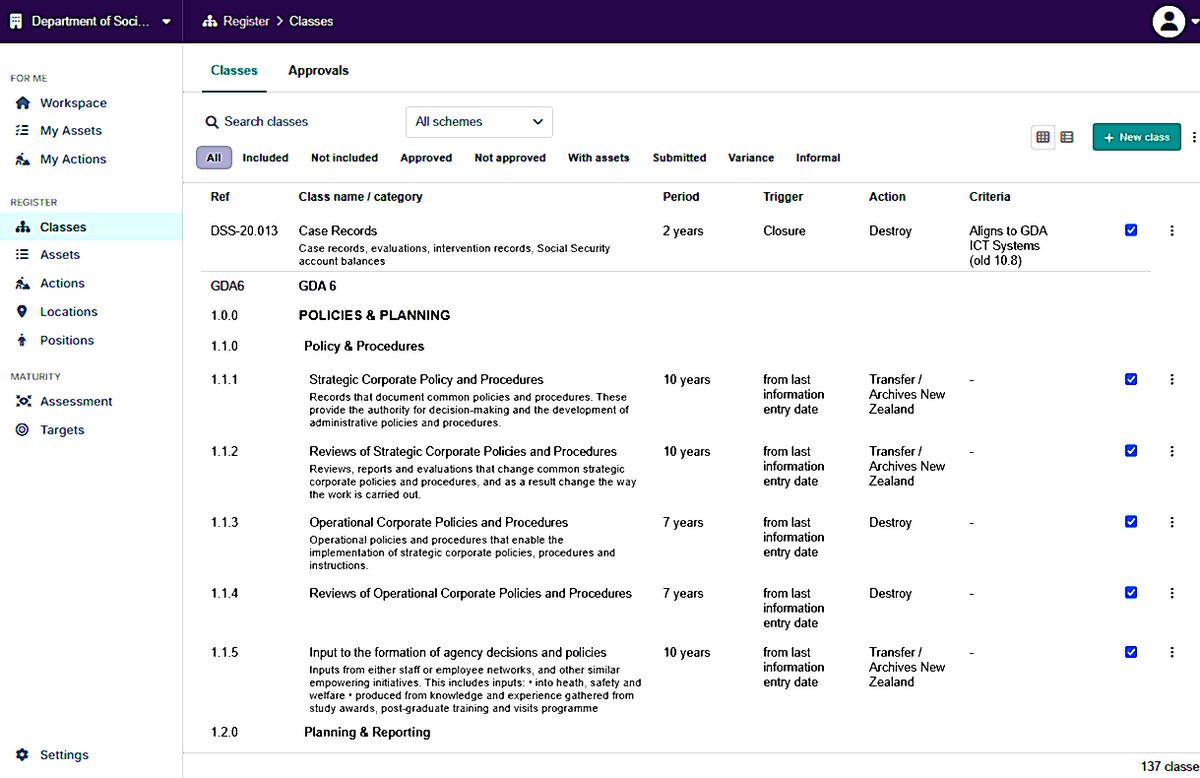
iar / register / classes
The register mapped to your disposal authority, every class with retention period, trigger, and disposal action
The register mapped to your disposal authority, every class in one sortable table with retention period, trigger, disposal action, and criteria.
Staying current

A register that doesn't become the next stale spreadsheet.

The hardest part of any register is keeping it alive. IAR is built so maintenance shrinks rather than grows, so your IM team spends less time rebuilding and more on the judgement only they can bring.

Less busy-work, more IM

Structured capture, position-based stewardship, and one source of truth remove the manual rebuilding, freeing your IM team's capacity for the work that actually lifts maturity.

Support where you need it

An optional support contract puts our team alongside yours (for migration, disposal rounds, or maturity uplift) so progress doesn't stall when capacity is tight.

AI-assisted disposal mapping

Record-level AI mapping across Microsoft 365 and other systems will propose disposal against your schedule (always for human review, never automatic) so classification keeps pace with what you actually hold.

Live Prototype
How IAR compares

Not a spreadsheet. Not an EDRMS. A register.

IAR governs the information you hold and proves it can be disposed of defensibly. Here is where it sits against the tools agencies reach for today.

CapabilitySpreadsheet / SharePoint listEDRMS / content systemIAR
Structured asset registerAd hoc, soon staleA document store, not a registerPurpose-built
Mapped to your disposal authorityBy hand, if at allPartial, per systemEvery asset to a class
Stewardship survives staff changeTied to a personTied to permissionsTied to positions
Maturity (IMMA) in the same placeNoNoBuilt in
Whole-of-sector regulator viewNoNoRegulator tier
Sits above your content systemsn/aIs the content systemGoverns across all
See it on your data

A walkthrough beats a brochure.

We will show you IAR against a real disposal authority and a real register, so you can judge it on your own holdings.